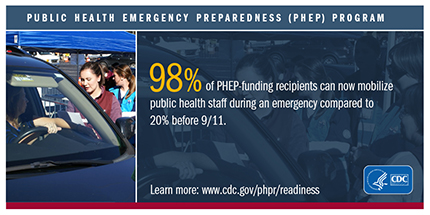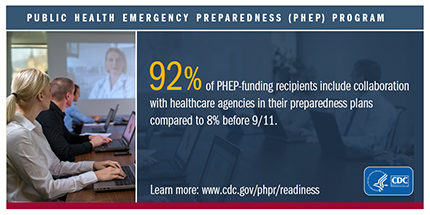
Florida is known for its resiliency in enduring and responding to all types of hazards, natural or man-made. Responding to these types of threats requires commitment and cooperation between communities, businesses, organizations and governmental agencies. One vehicle the state of Florida relies on to fund key preparedness and response capabilities is the Public Health Emergency Preparedness (PHEP) cooperative agreement from the Centers for Disease Control (CDC).
The PHEP cooperative agreement has been a critical source of funding for state, local, and territorial public health departments since its inception in 2002. This helps health departments build and strengthen their abilities to effectively respond to a range of public health threats, including infectious diseases, natural disasters, and biological, chemical, nuclear, and radiological events. Preparedness activities funded by the PHEP cooperative agreement specifically target the development of emergency-ready public health departments that are flexible and adaptable.
The Community Preparedness Section in the Bureau of Preparedness and Response (BPR) shares the Florida Department of Health (DOH) responsibility for supporting the state’s public health and health care systems to respond to disasters and other public health emergencies. Therefore, the Section is responsible for promoting and supporting preparedness activities at the local level by developing, evaluating, and providing technical assistance for accomplishing the County Health Department (CHD) Preparedness Expectations; serving as liaison and point of contact for questions, concerns and needs related to CHD Preparedness, and by seeking and allocating funds locally consistent with cooperative agreements and statutory authority.
The County Health Department (CHD) Preparedness Capabilities have been prioritized, built, and assessed using the CHD Preparedness Expectations since 2007. Every year, the Expectations are assessed, and evaluation evidence is provided by the CHD or retrieved from the statewide data bases. Since 2012, the Community Preparedness Section has been able to analyze data to assess the status of the local preparedness levels across the state.
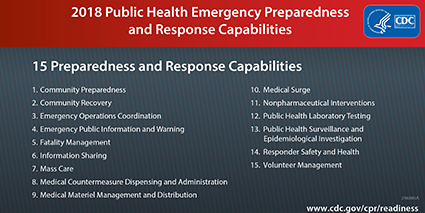
The Florida CHD Preparedness Expectations are closely aligned to the Center for Disease Control and Preventions publication Public Health Emergency Preparedness and Response Capabilities, National Standards for State, Local, Tribal, and Territorial Public Health, (October 2018), located at https://www.cdc.gov/cpr/readiness/capabilities.htm
The purpose of this application is to provide automation support of CHD Preparedness activities as outlined in the Department's CHD Expectations document. The purpose of this guidance document is to establish the framework to enhance and standardize the CHD Preparedness activities. Consequently, it:
The CDC PHEP cooperative agreement outlines key preparedness capabilities, organized into six domains and two tiers. Tier 1 capability standards form the foundation for public health emergency preparedness and response. Tier 2 capability standards are more cross-cutting, and their development relies upon having Tier 1 capability standards established in collaboration with external partners and stakeholders.
Although jurisdictional public health agencies should consider prioritizing development of Tier 1 capabilities, jurisdictional risk assessment findings and other community factors also may influence jurisdictional prioritization of some Tier 2 capabilities. For example, based on risk assessment findings and depending on the public health agency’s ESF #8 role, a jurisdiction also may need to prioritize development of volunteer management strategies to ensure staffing support for medical countermeasure dispensing and administration activities.
| Domain | Capability | Tier |
|---|---|---|
| Community Resilience | Community Preparedness | Tier 1 |
| Community Recovery | Tier 2 | |
| Incident Management | Emergency Operations Coordination | Tier 1 |
| Information Management | Emergency Public Information and Warning | Tier 1 |
| Information Sharing | Tier 1 | |
| Countermeasures and Mitigation | Medical Countermeasure Dispensing and Administration | Tier 1 |
| Medical Material Management and Distribution | Tier 1 | |
| Nonpharmaceutical Interventions | Tier 2 | |
| Responder Safety and Health | Tier 1 | |
| Surge Management | Fatality Management | Tier 2 |
| Mass Care | Tier 2 | |
| Medical Surge | Tier 2 | |
| Volunteer Management | Tier 2 | |
| Biosurveillance | Public Health Laboratory Testing | Tier 1 |
| Public Health Surveillance and Epidemiological Investigation | Tier 1 |
Each capability standard comprises capability functions, and each capability function contains specific capability tasks that are supported by multiple capability resource elements.